Today’s sentence:
“Battle through the foggy shroud, oh you wise fish of Saints, flee the earthly spires of this city of the damned and the pious faithful.”
Inspiration and Observation.
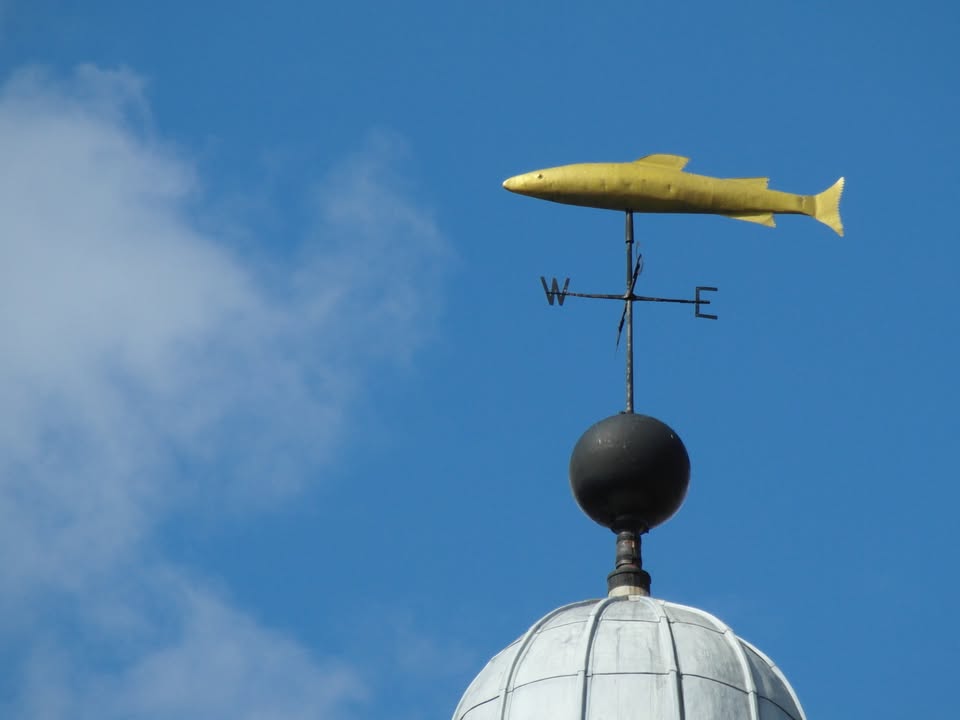
Have you ever heard of the ‘Goldie Fish’? Surely you must have. It leaps over Shandon Tower, and it is one of the most iconic Cork landmarks. It’s even on the Cork GAA crest.
You could be boring and state that it is an eleven foot three inches long weathervane, in the figure of a salmon gilded in gold leaf and was likely installed in the late 1750s. But surely it is more than that. This is an icon of Cork. An ancient symbol of the Christian faith and of Cork. Speaking to the Irish Examiner, local historian John Mustard said, “We don’t know where it was made,” says local historian John Mustard, who served as the church organist for 19 years “…it’s also an ancient Irish symbol and a symbol of Cork city; there was a salmon fishery down on the River Lee for years, run by the Franciscan Order.”
When I was growing up, they used to say that the smell of fish, was the smell of money; mind you they also used to say the same about cow shite, so I’m not claiming there were many roving countryside philosophers in the wilds of Mayo during the 1980s. Also speaking to the Irish Examiner about the tower, was Marisa O’Mahony, the Tower Manager at St Anne’s. “The salmon is a symbol of ambition as well, the gold salmon was a statement, as if to say, we’re here. The McOstrich family were wealthy merchants in the city, and they were heavily involved in the planning and funding of it.”
The weathervane is on the Shandon Tower, which is home to the Shandon Bells, those of the famous poem and ballad, ‘The Bells of Shandon’, by Francis Sylvester Mahony. The tower is also home to a clock face on each side, which naturally tells four slightly different times of day, and it is this triumph of horology which has more than earned it the sobriquet, ‘The Four-faced Liar.’ All the above are attached to St. Anne’s Church.
St. Anne’s is a truly beautiful building, and its own website proclaims it as, “the most important ecclesiastical structure of any period, within the city of Cork, and one of the most important early 18th century churches in Ireland.”
So, all in all, well worth a visit the next time you are in Cork, or if you are within earshot of its bells, maybe pause and look up, and see if that salmon is still flashing its fancy tail as the city below.
A note on my sentence today:
I am fascinated by Churches, and other ecclesiastical structures. The power of faith of days gone by in Ireland, and in many other places around the world, is something that many of us in the very modern age do not comprehend well enough.
When I was young, they were raising money to build grottos and struggling at times. Many of the most incredible places of faith where not just build by wealthy benefactors; they were often built by the subscription of the faithful, many who would have been of the most modest means imaginable.
I’m not talking about the purchase of a plenary indulgence; this was putting money (which you didn’t have) where your mouth was. These places of worship were raised to the glory of their God. Often, in the most magnificent of fashions.
Yet, even in the humbler holy places, there can be a nearly overwhelming sense of the past if you step softly and listen to the stones. A resonance of peace and respect.
I often think, when I go for a walk about these places, as is often our want when on holidays and such, that I am intruding somewhere privileged; somewhere, it is true, that sliver may have bought the stone, but where fervent prayers kept it piled one on top the other into the heavens.
I am also fascinated by faith. The blind kind.
When one stands back from Catholicism for example, which I’ll comment on from my own experience, it must terrible odd to anyone outside it. Extraordinary isn’t the word.
Confession for example, or The Sacrament of Penance to give it its more formal title, one of the seven sacraments of the Catholic Church. What a masterstroke from about 350-400 AD. You tell your most intimate sins to the local Priest, and he absolves you of the sin, IF you are truly remorseful and complete a penance. (Yes, I know it’s more complicated than this, but this is a daily writing exercise not a novel).
But don’t worry, they’ll not use that against you at all at all, the confessional is sacrosanct.
Now, please note that I am talking about the early church, which has gotten so bad that in 1517, there was a small hiccup called The Protestant Reformation.
Which leads us back to the purchase of a plenary indulgences, which may or may not have been a thing. However, some of the biggest bastards in history built some of the most amazing churches, so maybe the Church didn’t believe in them, but surely some of the most black-hearted monarchs and wealthy of Europe certainly thought it wise to hedge their bets.
The sentence lodged for later use as:
- “A blanket of fog covered the city and the spire of Shandon struggled to break through.”
It evolved as:
- “The fish of Saints and knowledge struggled to break free of shroud, to race the pious spires heaven ward.”
- “The wise fish of Saints, battled through the foggy shroud, to race the spires heaven ward, oer the city of the sleeping dammed and the awakened faithful..”
- “The wise fish of Saints, battled through the foggy shroud, fleeing the pious spires which stretch heaven ward over the city of the sleeping damned and the awakened faithful.”
- “Battle through the foggy shroud, oh you wise fish of Saints, flee the earthly spires of this city of the damned and the pious faithful.”



 Paper Never Refused Ink!
Leave a comment