
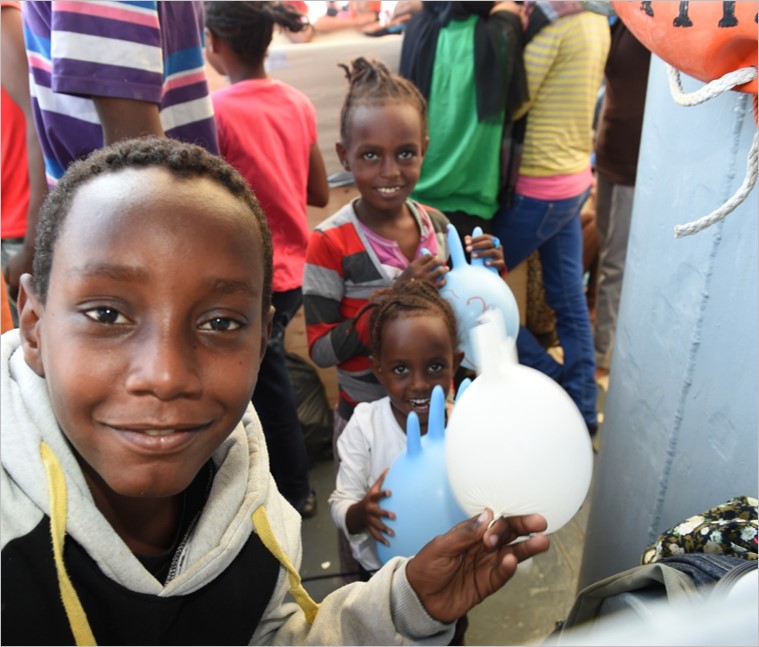
Faces.
I draw faces on the nitrile* gloves with care,
never more struck by my privilege,
until I meet those without a home,
a child alone,
the laughter and delight at a simple toy,
a joy,
they are gathered at my feet,
their little bundles stand out in stark relief,
drawing in the bright sun,
on expensive paper with cheap crayons.
Children from the opposite sides of a continent,
separated by a vast expanse yet inseparable now,
sons of Ishmael and Isaac,
divided by words in a book,
one blue, the other amber through my sunglasses,
sharing a cardboard mat as worn-out parents lay against the hangar door,
stress etched on their faces yet absent now in these little artists.
Their drawings made tears fall later as I sat and stared at the pages,
a little token offered up in friendship,
from tiny hands without shoes,
a village where a family lived and granny sat outside,
a car of an uncle that used to go so fast,
the battle in the streets,
where Technicals* blaze bright tracer fire,
and the roaring jets drop bombs.
One home has lurid yellow thatch,
while the other is a burnt-out shell,
smoke curls out of shattered windows,
in the other, a pet dog abandoned wags its tail,
one child escaping poverty,
the other hell,
the stick figures have names and stories,
except those who are lying still,
floating on red tides,
as the sun beats down on my neck,
blowing glove balloons.
By Ruairí de Barra.
“These words are not just my own experiences, they are also the stories and memories of my friends and colleagues. The crew of LÉ Eithne, whom I was privileged to be part of, rescued 3,376 people in 63 days in 2015. The Irish Naval Service, since that first mission, has rescued over 18,000 people. These poems are also the stories of the migrants and refugees; in particular, they are written in memory of those poor people who never made it. They lie along the trail of bones in the desert or were lost at sea. I write these words to say that I saw you and that none of us will forget you.”
First published in A New Ulster, Issue No. 62, 1 December 2017. I would like to thank Amos Greig for seeing fit to include my work in the company of some incredibly talented people. I am so pleased that this is my first poetry published in print in Ireland.
You can visit the A New Ulster website here:
https://anuanewulster.wixsite.com/anewulster/recently-in-anu
Or read it online for free on ISSUU here:
https://issuu.com/amosgreig/docs/anu62
Or, if you are so inclined, you can purchase a print copy and help support A New Ulster, which provides such wonderful publications each month, by visiting the address below. The poets and writers in its pages receive no payment for their work, and I am sure it isn’t easy for Amos to produce this monthly magazine; the hours of reading submissions alone must be incredible.
https://www.peecho.com/print/en/321929
Notes:
(*Nitrile gloves are non-latex sterile rubber gloves with superior puncture resistance. The Naval Service crew wear two gloves to prevent infection: white as the inner glove and blue as the outer, so that a puncture in the outer glove will stand out and it can be quickly replaced.)
(*Technical is the term for light improvised fighting vehicles, which are ubiquitous across Middle Eastern and African conflicts. A technical is often an open-backed four-wheel-drive pickup truck with a heavy machine gun, anti-aircraft gun, recoilless rifle or rocket launcher mounted on the back.)


Leave a Reply